Oasis LMF Documentation
What is Oasis: The Oasis Loss Modelling Framework is an open source catastrophe modelling platform, free to use by anyone. It is also a community that seeks to unlock and change the world around catastrophe modelling to better understand risk in insurance and beyond. While its development is largely driven by the global (re-)insurance community, it seeks to provide tools and utility to all. For more information visit oasislmf.org.
How this documentation is organised: Each Oasis component owns and publishes its own documentation. This site aggregates those component sites — pinned to specific versions — into one place. Pick a component below, or start from a use case.
Overview
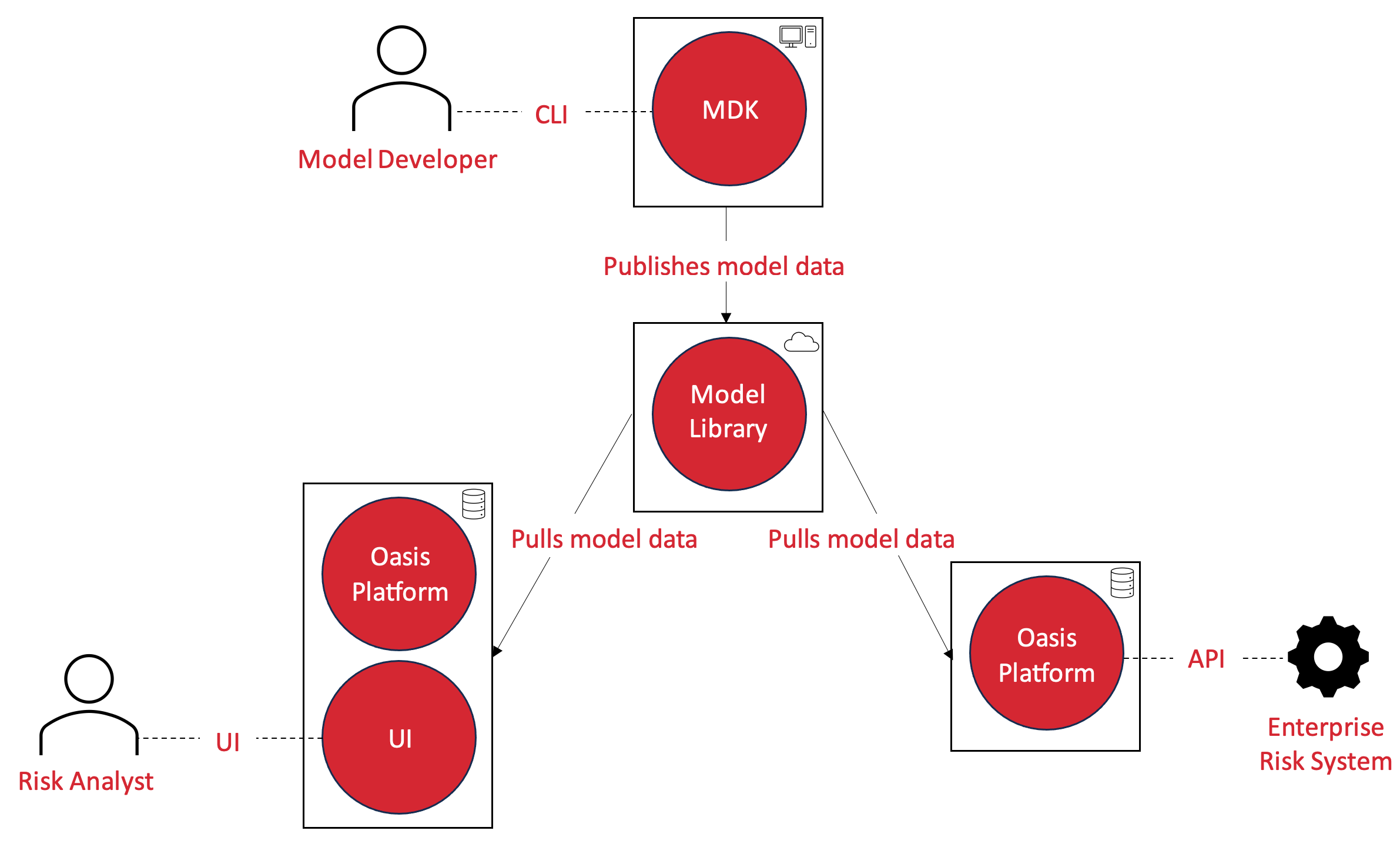
Oasis Ecosystem
Documentation by component
The Model Development Kit and the loss-calculation kernel (pytools): GUL, FM, outputs, keys/lookup, methodology.
The API, workers and deployment — running models at scale, and driving them via the API.
Loading/validating OED, transforming to OED (ODTF), and the analysis/model settings schema reference.
The exposure data standard — file structure, hierarchy, field and coded-value reference.
The results data standard — result tables, fields and worked examples.
Example and reference models (e.g. PiWind) and how model data is packaged.
The Oasis initiative
Model developers build, test and publish risk models — typically scientists or software developers in a modelling company or academia.
Risk analysts operate the models for decision support — analysts at (re)insurers running models for pricing and portfolio management, plus government and third-sector users.
Enterprise risk systems integrate Oasis models via APIs into pricing and portfolio management workflows.